Hovawart Size: Planning for a Substantial Adult
Understand Hovawart size in practical terms: measuring, travel equipment, resting space, handling, and questions about an individual adult.
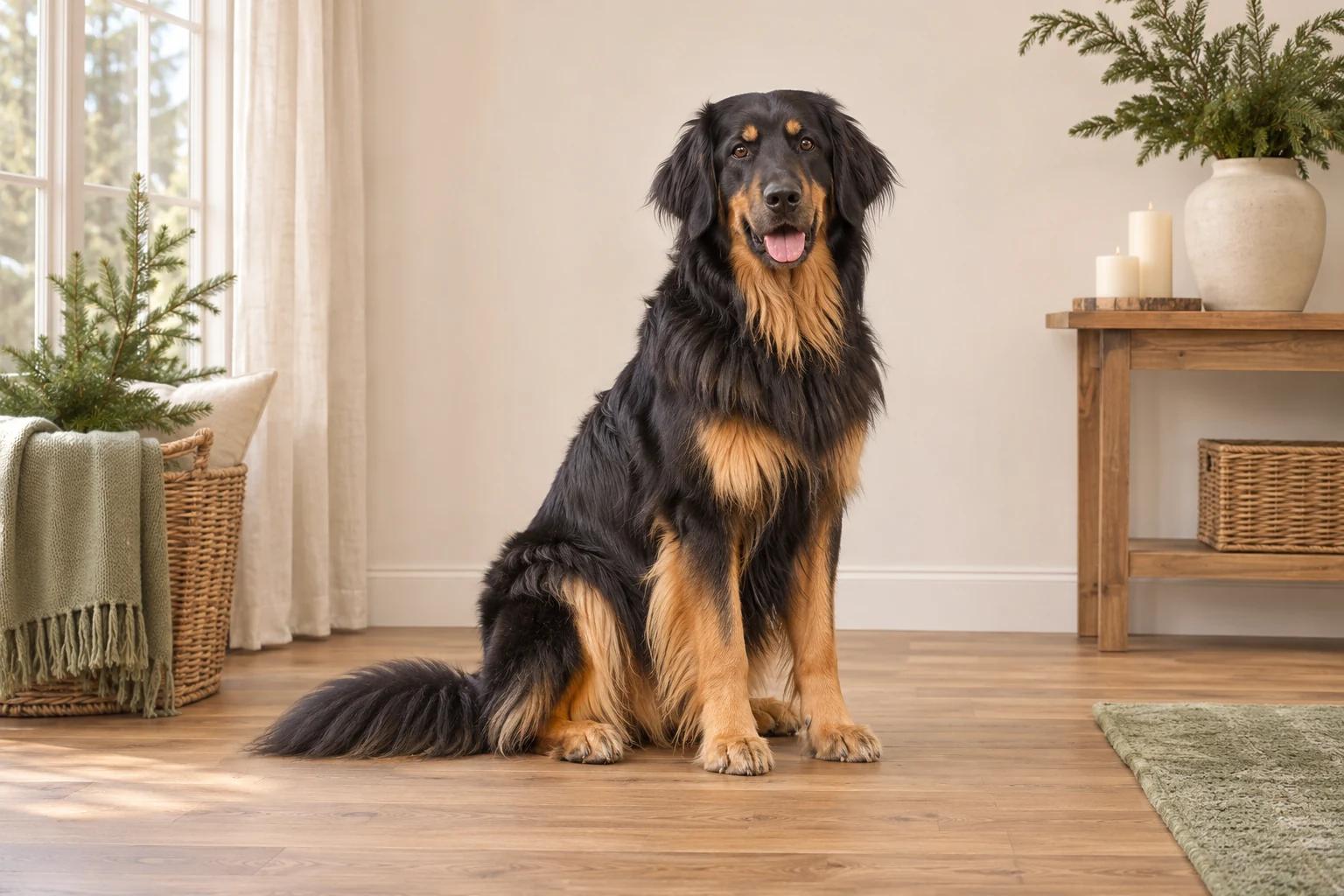
Hovawart size matters most when you translate it into everyday space and handling. A puppy may fit easily beside your chair; the adult needs room to turn, stretch, travel, and move through the house without constant rearrangement. Planning for that adult is more useful than trying to predict a final measurement from one puppy photograph.
The Hovawart profile provides a general adult reference. Use it to begin planning, then obtain measurements and background for the particular dog. Equipment should fit the dog in front of you, not an average imagined from a breed label.
Hovawart size is more than a number on a scale
My Breed Atlas currently lists adult Hovawarts at 55–99 pounds and 23–28 inches tall. Its weight references are 55–77 pounds for females and 75–99 for males. These ranges describe adults collectively; they are not an exact puppy-size forecast or a feeding target.
The UKC standard describes a powerful dog, with males generally larger and more substantial than females. It also describes a body longer than it is tall. Those details explain why shoulder height alone cannot tell you how much floor space or travel space an individual needs.
The Hovawart Club of North America emphasizes that owners must be able to manage a large, strong dog. That is a practical consideration, not a reason to seek the largest possible example. Think about your routes, equipment, and support rather than treating weight as an achievement.
For planning, separate three measurements: standing height, body length, and weight. They answer different questions. A harness also requires its own fitting measurements. A dog can fit a product's stated weight range while still having the wrong proportions for its shape.
Measuring height without turning it into a struggle
Hovawart height refers to the shoulder, not the top of the head or the ears. If you need a measurement, ask someone experienced to demonstrate how to take it while the dog stands naturally on a level surface. A moving dog, sloping floor, or ruler held at an angle can make the result misleading.
Do not repeatedly reposition an uncomfortable dog just to obtain a neat number. A rough home measurement can be useful for preliminary planning, but a careful fitting or assessment is better when the result affects equipment. Record the date and the method so that later comparisons mean something.
A photograph beside a sofa is not a reliable measuring tool. Camera angle, coat, posture, and the sofa itself can all change the impression. When a seller or caregiver describes a dog as unusually large or small, ask what was actually measured.
Weight belongs in a record, not a competition
Hovawart weight is useful for equipment limits and veterinary records, but it is not a standalone assessment of body condition. Your veterinarian can interpret weight alongside the dog's build, age, and history. Do not increase food merely to reach a breed figure or copy another owner's portions.
When collecting records for an adult dog, ask for the date of the last weight rather than accepting an undated estimate. If you are checking a carrier, ramp, or other load-bearing item, use the manufacturer's guidance and leave the final fitting decision to a suitable professional where needed.
For a growing puppy, ask the breeder what is known about the parents and other relatives. That information can guide expectations without producing an exact adult forecast. Avoid spending heavily on permanently fitted items before you know whether they will remain suitable.
Walk through the home at adult scale
Start with the resting area. Imagine the dog lying on its side, getting up, and turning around while someone walks past. A bed may physically fit in an alcove but leave no comfortable route around it. Measure the available floor area, not just the space between furniture legs.
Next, check bottlenecks. Can two people and the dog pass through the hall without stepping over one another? Does opening the refrigerator block the route to the water bowl? Is the preferred resting spot also the path to the bathroom at night?
These are layout problems you can solve before arrival. Move a side table, choose a different bowl location, or establish an alternative resting spot. The aim is not to create a showroom with no dog in it; it is to avoid making every routine task a negotiation over limited space.
Include the dog's long coat in your practical thinking. Leave room to approach both sides during care and to lay out a towel after wet weather. A cramped corner may be fine for storing a bed but awkward for checking equipment or drying a dog.
Plan the journey as carefully as the destination
Before buying travel equipment, measure the actual vehicle opening and usable interior. The boot's advertised volume does not tell you whether a particular enclosure will pass through the hatch or sit securely inside.
Check the manufacturer's fitting and restraint instructions. Consider where luggage will go, whether another passenger uses the same space, and how the dog will enter and exit at the places you regularly visit. A workable arrangement at home may be awkward in a narrow car park.
Practice the loading routine without rushing to leave. If assistance is needed, discuss an appropriate approach with a professional rather than assuming you can lift an adult Hovawart whenever necessary. Make a backup transport plan for a day when your usual vehicle or helper is unavailable.
The question how big do Hovawarts get often begins as curiosity, but travel planning turns it into a concrete decision. An adult's measurements should be checked against your actual equipment before a long journey, not discovered to be incompatible on departure morning.
Strength makes small manners valuable
A dog does not need to be unusually large for pulling at a doorway to become inconvenient. Plan to teach waiting while equipment is attached, moving aside, and walking with a comfortable lead. These are useful household skills, not tests of dominance.
Invite every regular handler to learn the same routine. If a friend will cover walks, do a practice outing together rather than handing over the lead with a quick verbal description. Ask whether the friend is comfortable with this particular dog and route.
Choose storage that keeps equipment accessible. Searching for a lead while a substantial dog crowds the exit makes a simple departure unnecessarily complicated. A consistent preparation area gives both person and dog a clearer sequence.
Questions that improve an adult-size estimate
Ask for actual parental measurements, the puppy's dated records, and the caregiver's experience of related adults. For an adult adoption, request current measurements and arrange a fitting where appropriate. Distinguish information that is known from an estimate.
The Hovawart history article addresses the breed's development rather than predicting an individual's body. The breed quiz can help you think about space and routine alongside size. Use those resources to frame questions, not to turn a broad description into a promise.
FAQ
Does shoulder height tell me what crate to buy?
A Hovawart's shoulder height alone does not determine the right crate size. Body length, standing and turning space, the individual dog's measurements, and the equipment manufacturer's instructions also matter. Check the actual fit rather than selecting solely by breed name.
Will a male Hovawart always be larger than a female?
The breed standard describes males as generally larger and more substantial. That does not establish the size order of every individual pair. Ask for measurements when size affects your plans.
How big is an adult Hovawart?
My Breed Atlas lists adult Hovawarts at 55–99 pounds and 23–28 inches tall, with female weight references of 55–77 pounds and male references of 75–99 pounds. These are collective reference ranges, not individual targets. Use measured dimensions for fitted equipment.
Should I feed a Hovawart to reach a target breed weight?
A Hovawart should not be fed toward a generic breed-weight target. Discuss feeding and body condition with your veterinarian. A general breed reference is not an individual feeding target, and weight alone does not describe the dog's condition.
Sources behind this article
Article source checked: November 16, 2026. Source checked 2026-11-16
Keep reading

Airedale Terrier Temperament: What Everyday Life Can Feel Like
Read article →