European Burmese vs Burmese: names, build and daily company
Compare European Burmese and Burmese cats through adult weights, registry identities, physical build and the kind of company each individual enjoys.
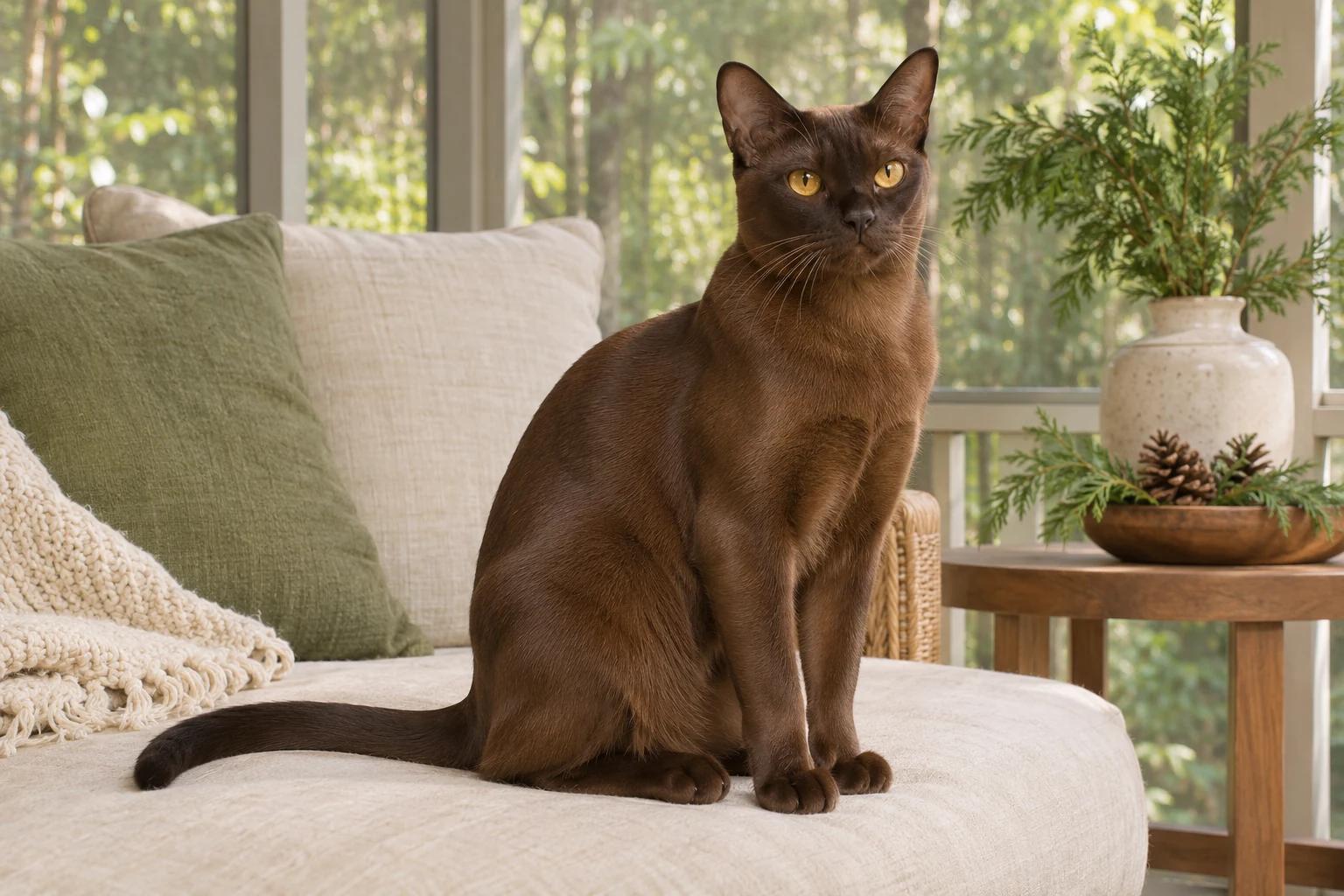
European Burmese vs Burmese is not a choice that can be settled by which name sounds more familiar. Start with the actual cat and the identity used in its records, then compare adult size and the relationship you want. This guide treats the two My Breed Atlas profiles separately, rather than assuming that an advertisement tells you everything about an animal.
European Burmese vs Burmese: compare the current adult ranges
The current European Burmese profile lists females at 7–10 pounds and males at 10–14 pounds. The Burmese profile lists females at 6–9 pounds and males at 11–14 pounds. These are adult reference ranges, not predictions for a particular kitten.
The overlap is substantial. The female ranges overlap from 7 through 9 pounds, while the male ranges overlap from 11 through 14 pounds. A nine-pound female therefore does not distinguish these two identities. Nor would a twelve-pound male. Weight alone cannot tell you whether a cat is a European Burmese or Burmese.
Notice also that the female European Burmese range starts and ends a pound higher, but the male Burmese range starts a pound higher. That is not a consistent all-purpose size ranking. “Which breed is bigger?” loses useful information if the answer ignores sex and individual variation.
If you are comparing two adults, their own recorded weights are more useful than choosing the upper end of one breed range and the lower end of the other. If you are comparing kittens, do not treat their present difference as a forecast of the adults they will become. Keep an adult reference range separate from the measurements of the cat in front of you.
Why two names developed
The European Burmese Breed Council's history, written by Ann-Louise De Voe, traces the divergence through breeding and exhibition history. American Burmese reached England in 1949. The council describes changes to the CFA standard in 1959 as an important step in the difference between American type and that developing elsewhere.
In 1993, CFA discussed admitting the Burmese type exhibited in FIFe, GCCF and Australian associations under a separate standard. The name European Burmese replaced the proposed Foreign Burmese. Championship status in the United States followed in 2002.
For someone weighing Burmese vs European Burmese, that history explains why the extra word matters. It is not simply a claim that an individual was born in Europe. Equally, a cat's country of birth does not by itself describe the standard behind its registered identity. Ask which association and breed name the documentation actually uses, rather than trying to reconstruct identity from a location in an advertisement.
Look at the Burmese as a whole cat
The CFA Burmese description and standard emphasize a compact, muscular body, substantial bone and a rounded head. The muzzle is short and broad, the chest rounded, and the paws round. The very short coat lies close to the body rather than forming a long outline of its own.
Those details make a more useful visual comparison than a single weight figure. Look at the relationship between the torso, head and limbs, not just the apparent width of the face in one portrait. “Compact” describes an arrangement of proportions; it does not mean that the cat must be light.
CFA also describes weekly brushing with a rubber brush for the Burmese coat. That is a concrete care task to discuss with the person who knows the cat. Ask to see the familiar tool and how the cat participates, rather than interpreting a short coat as an absence of care. This is a description of the Burmese routine, not a reason to impose exactly the same handling session on every cat you meet.
Make room for shared activity, not an intelligence contest
TICA's Burmese account describes an interest in games, tricks and puzzle or interactive toys. It also describes a soft voice and interaction with familiar people. These are useful prompts for a conversation about daily life, not a scoring system for deciding which of the two breeds is cleverer.
When meeting a Burmese, ask what an ordinary game looks like. Does the caregiver move a toy, offer a puzzle or cue a familiar learned action? Those are different activities. Watching the actual interaction tells you more about your likely participation than hearing that a cat is “intelligent.”
If you are choosing a European Burmese or Burmese, compare the individuals using the same practical questions. A demonstration of one familiar game is not a fair competition against an unfamiliar task offered to another cat. You are finding out what each animal enjoys and what you would share with it, not awarding a winner. Keep the emphasis on the activity itself rather than on a label that promises effortless entertainment.
Read the registry name in context
The World Cat Congress comparison lists European Burmese under CFA and directs readers to Burmese for the other member organizations shown. That makes registry context a real part of the difference between European Burmese and Burmese, rather than a technical detail to ignore.
A useful question is therefore “What name appears in this cat's records, and under which organization?” It is more precise than asking whether someone uses the shorter name in casual conversation. Do not assume that two advertisements using Burmese are describing identical registration categories, or that two differently worded labels necessarily describe an entirely unrelated background.
Our cat breed quiz can help organize your preferences. For the separate practical issue of feeding several cats, see separate meals for a European Burmese; breed identity does not replace an individual household arrangement.
Frequently asked questions
Can adult weight distinguish these cats?
No. The current sex-qualified profile ranges overlap substantially.
Does European Burmese mean a cat was born in Europe?
No. Here it identifies a breed category, not an individual birthplace.
Should I choose whichever kitten weighs more?
Not on that basis alone. Present kitten weight is not an adult-size prediction or a measure of how well the individual fits your preferences.
Sources behind this article
- European Burmese Breed Council history ↗
- CFA Burmese ↗
- TICA Burmese ↗
- World Cat Congress European Burmese comparison ↗
Article source checked: November 16, 2026. Source checked 2026-11-16
Keep reading

Abyssinian vs Somali: Coat, Size and Everyday Company
Read article →