Dogo Argentino size: adult ranges and practical fit
Understand Dogo Argentino height and weight ranges, then plan transport, equipment, handling and growth checks around the individual dog.
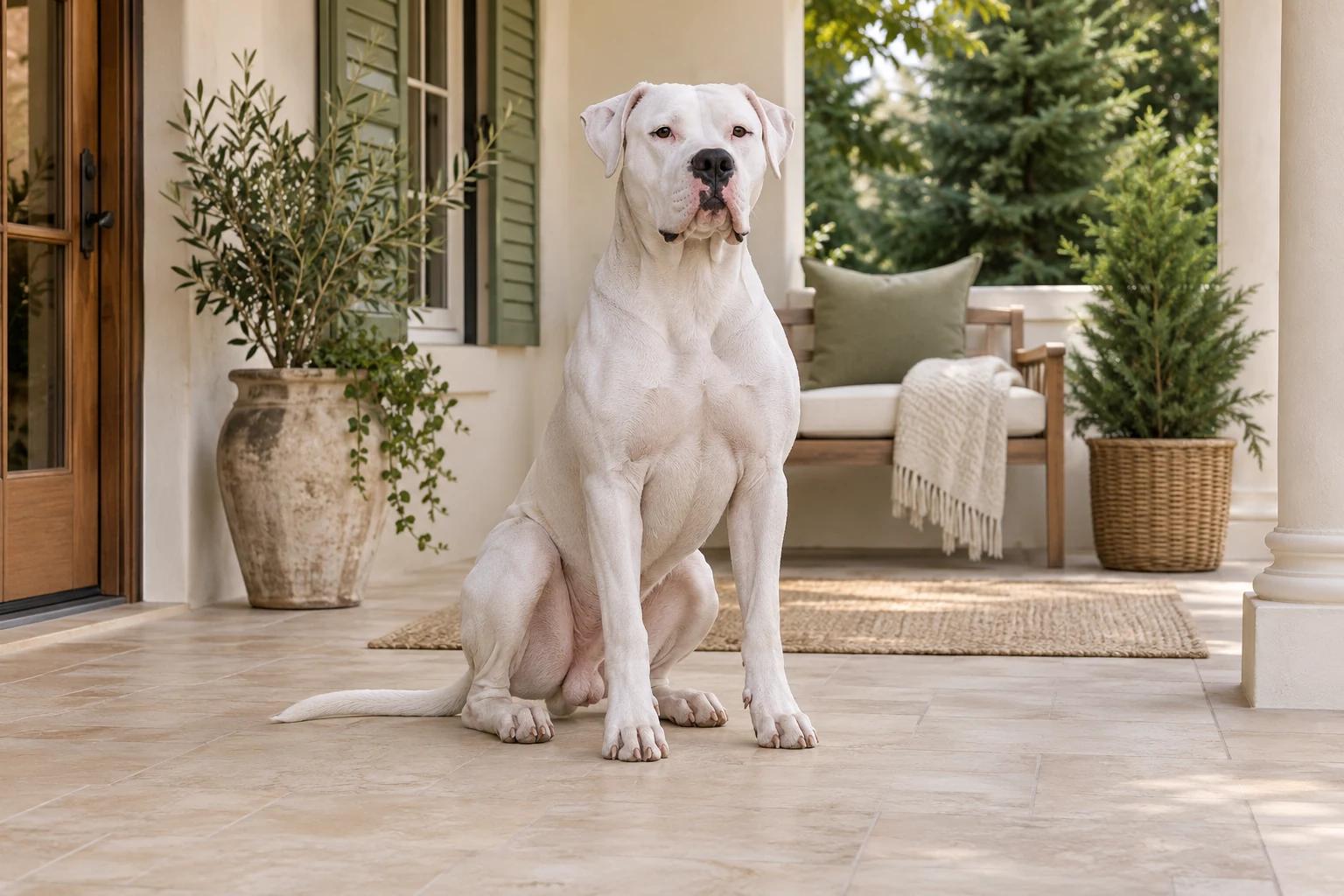
Dogo Argentino size is a practical ownership question before it is a statistic. My Breed Atlas lists adult males at 24–26.5 inches and females at 24–25.5 inches at the shoulder, with an adult weight range of 88–99 pounds. Those figures describe a substantial dog whose equipment and living arrangements deserve planning before arrival.
Use the Dogo Argentino profile as a starting reference, then work from the measurements of the individual dog. An adult range is not a promise about a puppy, a target to achieve through feeding or a reason to prefer the largest animal available.
Dogo Argentino size means an athletic, muscular frame
The FCI breed standard describes a powerful, agile dog with a slightly rectangular body and substantial musculature. That outline explains why shoulder height alone does not tell you how the dog will fit in a car, turn in a hallway or wear a harness.
Think in three dimensions. Height matters for overhead clearance; length and width matter when the dog turns or lies down. Weight matters when equipment has a load rating or when you need help moving the dog. A product marked for large breeds may address only one of those considerations.
Make a short measurement sheet rather than relying on memory in a shop. Record the date, the dog's current weight and whichever measurements the product manufacturer requests. For a growing dog, keep the sheet current and check equipment regularly instead of buying something loose enough to last indefinitely.
Understanding Dogo Argentino height
Height is measured at the withers, the top of the shoulders, not at the ears or the top of the head. A photograph taken from below can make a dog appear much taller, while a crouched posture can make it appear smaller. Comparisons based on pictures therefore have obvious limits.
If you need a measurement, ask the breeder, rescue or veterinary team to show you a calm, straightforward method. The dog should stand naturally on a level surface. Avoid holding it rigidly in an awkward position to obtain an exact-looking number. Approximate household planning does not require staging a show examination.
Keep units consistent. Write inches or centimeters beside the figure rather than assuming everyone knows which you used. This is especially important when ordering equipment internationally or comparing a manufacturer's diagram with information from another country. The measurement points in the diagram matter as much as the unit.
Dogo Argentino weight is not a body-condition score
Two dogs at the same weight can differ in frame and condition. A breed range cannot tell you whether an individual is carrying an appropriate amount of body fat or whether a growing puppy is progressing as expected. Bring those questions to your veterinarian rather than trying to diagnose from the scale alone.
VCA's guidance for large and giant breeds emphasizes reviewing food intake, growth and body condition with the veterinary team. Feeding more to chase a large adult number is not a sound growth objective. A puppy needs an individual plan rather than an internet competition over who owns the heaviest Dogo.
For appointments, keep a simple dated weight record and note which scale was used. Bring the food label and an accurate description of meals and extras if you are discussing nutrition. You do not need to invent a monthly breed growth curve to have a useful conversation.
Fit the adult dog into the actual household
Walk through the route from the sleeping area to the outside door. Notice tight corners, furniture legs, loose rugs and places where two people commonly pass each other. A bed placed in the narrowest part of a hallway may create a daily obstacle even if the room itself is generous.
Mark a possible bed footprint with removable tape before purchasing. Check that doors can open and that people can move past without stepping over the dog. Include enough space for the individual to change position comfortably, not merely curl into a compact photograph-ready pose.
A garden does not erase indoor logistics. The dog still needs a workable resting area and a manageable route through doors. If you live in shared housing, think through the lift or corridor as carefully as the living room. The question is not just whether the dog fits, but whether ordinary movement remains calm and practical.
Check transport before bringing the dog home
Measure the usable space after installing any transport equipment, not the empty vehicle. Account for sloping roofs, wheel arches and the space taken by a crate's frame. Check the opening through which the dog enters as well as the space inside.
Follow the equipment manufacturer's fit and installation instructions. A crate name such as extra-large is not a universal measurement. If using a restraint system, check its stated specifications for the individual dog rather than assuming a harness sold for walking is automatically suitable for transport.
Plan for situations in which the dog cannot enter normally. Ask your veterinary team how to prepare for assisted movement if it ever becomes necessary, and identify someone who could help. This is not a prediction of a problem; it is part of owning an animal you may be unable to lift comfortably on your own.
How big do Dogo Argentinos get in everyday terms?
Expect the adult to affect decisions about furniture layout, secure transport, equipment and who can handle walks. That is the useful meaning of the size range. A dog at the lower end still needs competent management, while a larger dog does not become more suitable merely because the owner has a large house.
Ask to meet adult relatives when possible, or obtain reliable measurements and descriptions from a rescue caregiver. Look beyond appearance: how does the dog move around people, wait for its leash and settle in a normal room? Those observations help turn a number into a realistic ownership picture.
For broader matching questions, use the breed quiz. Keep size research distinct from screening research; the existing BAER and CHIC article explains a different set of records. Neither a measurement nor a screening label settles every question about a dog.
FAQ
What is the adult Dogo Argentino weight range?
My Breed Atlas lists 88–99 pounds as the adult reference range. It is not an individual ideal weight. Your veterinarian can assess body condition and an appropriate target for your dog.
Are male and female Dogos very different in height?
The listed shoulder-height ranges overlap: males are 24–26.5 inches and females 24–25.5 inches. Sex alone therefore does not predict which of two individual dogs will be taller.
Can puppy paw size predict adult size?
Paw size is not a dependable substitute for a growth assessment. Use family information, dated measurements and veterinary guidance rather than treating one visible feature as an adult-size forecast.
What crate size does a Dogo need?
Choose from the individual dog's measurements and the manufacturer's instructions, not a breed-name label. Check standing, turning and resting space as well as the crate's fit in your vehicle or home.
Sources behind this article
- FCI: Dogo Argentino standard 292 ↗
- VCA: Nutritional Considerations for Large and Giant Breed Dogs ↗
- FCI approximate standard weights — adult-weight reference ↗
- AKC approximate standard weights — adult-weight reference ↗
Article source checked: November 15, 2026. Source checked 2026-11-15Article source checked: November 18, 2026. Source checked 2026-11-18
Keep reading

Airedale Terrier Temperament: What Everyday Life Can Feel Like
Read article →