Cornish Rex vs Devon Rex: coats, shape and everyday life
Compare Cornish Rex vs Devon Rex weights, head shapes, coat structure and everyday activity without assuming two curly-coated cats are interchangeable.
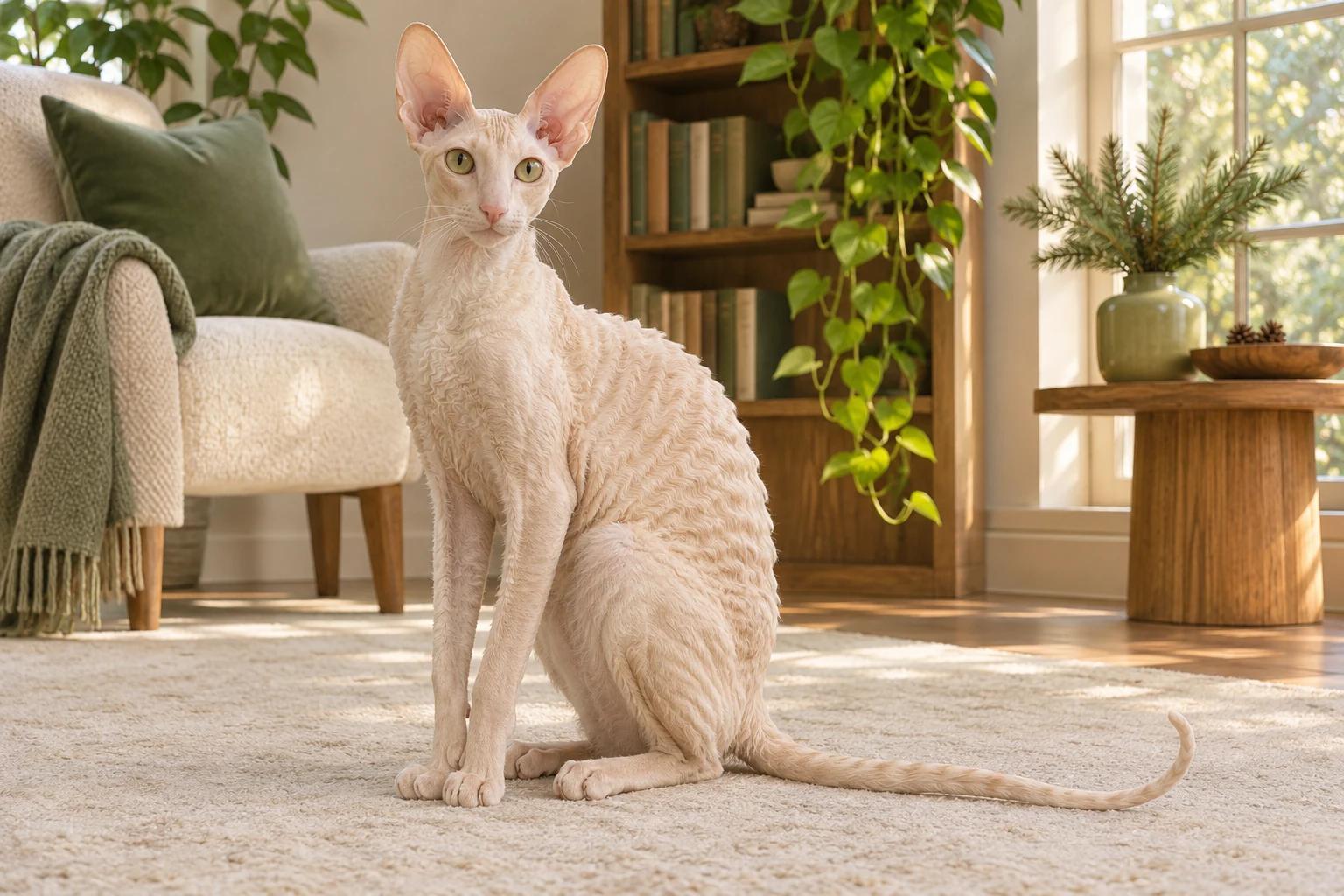
Cornish Rex vs Devon Rex starts with two individual cats, not a competition between breed names. Compare the current adult weight references, then work through the practical differences before choosing.
Cornish Rex vs Devon Rex: the current adult weights
The Cornish Rex profile lists adults at 5–10 pounds overall, with females at 5–7 pounds and males at 8–10 pounds. The Devon Rex profile lists 5–9 pounds overall, with females at 5–7 pounds and males at 7–9 pounds.
The female references are identical, while the male references overlap from eight to nine pounds. That makes a blanket statement that every Cornish is larger than every Devon unhelpful. An eight-pound adult male fits both references; a six-pound adult female also fits both female intervals.
These examples compare like with like. They do not identify a cat from its weight, and they do not establish an appropriate weight for a particular individual. The overall maximum is also not a measured average. When considering two actual adults, their own measurements are more informative than picking the breed with the larger upper endpoint. Ask your veterinarian about an individual's weight rather than trying to make it match a preferred number.
The Cornish outline: look beyond the waves
CFA's Cornish Rex description identifies an arched back, an egg-shaped head, large ears set high and a prominent Roman nose. The coat lies close to the body in waves and lacks guard hairs, giving it its distinctive soft texture.
That combination helps distinguish the Cornish outline from a general impression of “large ears and curls.” Look at where the ears sit in relation to the head, then at the head's overall shape. The arch through the back is another feature of the whole animal, not something visible in a cropped face photograph. The coat is part of the appearance, but it is not the only structural clue when you are comparing the two breeds.
The Devon has a different face and coat structure
CFA's Devon Rex account describes large ears set low on the sides of the head, wide cheekbones and a short face. Its body is muscular, with a broad chest and slender neck. The combination differs from the Cornish's head-and-ear arrangement rather than being a smaller version of it.
CFA also explains that the Devon has sparse, short, curled guard hairs. Its coat can vary in density, texture and length. This is a structural distinction, not a claim that one breed's coat is automatically better or easier for every owner.
In a Devon Rex vs Cornish Rex comparison, therefore, separate the presence of curls from the way the coat is built. Both may look wavy, yet the descriptions are not interchangeable. Nor does one particularly full-coated Devon photograph establish that every Devon will have precisely that appearance. The individual remains important even within a recognizable breed type.
What the Cornish curl research explains
The UC Davis Veterinary Genetics Laboratory identifies a variant in the LPAR6 gene associated with the Cornish Rex coat. The laboratory describes the curly-coat trait as recessively inherited and fixed in the breed. Its explanation concerns a specific coat variant, not a general gene for being an entertaining companion.
For a reader comparing breed descriptions, “recessive” explains how the trait is inherited; it does not mean the coat is less noticeable or less important. The laboratory's distinction between carriers and cats showing the coat also separates a genetic description from appearance. A carrier can have an ordinary-looking coat without displaying that particular curly phenotype.
This information is useful background, not a recommendation to order a test or plan a mating. It helps explain why a visible feature and the underlying inheritance are different kinds of information. A result about this coat variant would not measure affection, trainability or adult weight. When choosing a Cornish Rex or Devon Rex, keep a scientific explanation of one physical trait separate from the wider question of living with a particular cat.
Picture activity in a real room
VCA's Cornish Rex profile describes an athletic, curious cat whose playfulness can persist into adulthood. Its examples include joining a person's keyboard work and investigating what the person is doing. That is more concrete than imagining activity only as a chase after a toy.
For someone who works at home, involvement may be enjoyable but also distracting. Ask how the individual behaves when a familiar person sits down to work: does it investigate the desk, attempt to occupy the keyboard, or settle after looking around? These are different experiences even when all are described casually as “helping.”
The same distinction matters during play. Running across a room, investigating an object and approaching a person are not identical activities. Describing what the adult actually does is more useful than calling it kitten-like and stopping there. This is an application of the Cornish profile, not evidence that every Cornish is more active than every Devon. No breed comparison can rank two individuals accurately without observing them.
For a separate question about clothing, read Cornish Rex indoor clothing considerations. The cat match quiz can help organize the broader ownership choice.
Frequently asked questions
What is the difference between Cornish Rex and Devon Rex adult weight references?
The current Cornish Rex and Devon Rex female references are both five to seven pounds. Male Cornish Rex references are eight to ten pounds; male Devon Rex references are seven to nine. These ranges overlap.
Is the breed with the higher maximum always the heavier cat?
A Cornish Rex is not always heavier than a Devon Rex. Range endpoints do not predict individuals; compare actual adults of the same sex and age category.
Can the middle of a breed range be treated as its average?
Neither the Cornish Rex nor Devon Rex reference midpoint is a measured breed average. A midpoint uses endpoints; a measured average requires observations from a defined group of cats.
Sources behind this article
Article source checked: November 16, 2026. Source checked 2026-11-16
Keep reading

Abyssinian vs Somali: Coat, Size and Everyday Company
Read article →