Cornish Rex training: practical skills and small movement games
Plan Cornish Rex training around useful carrier practice, clear movement cues and simple obstacle skills, without treating breed reputation as a lesson.
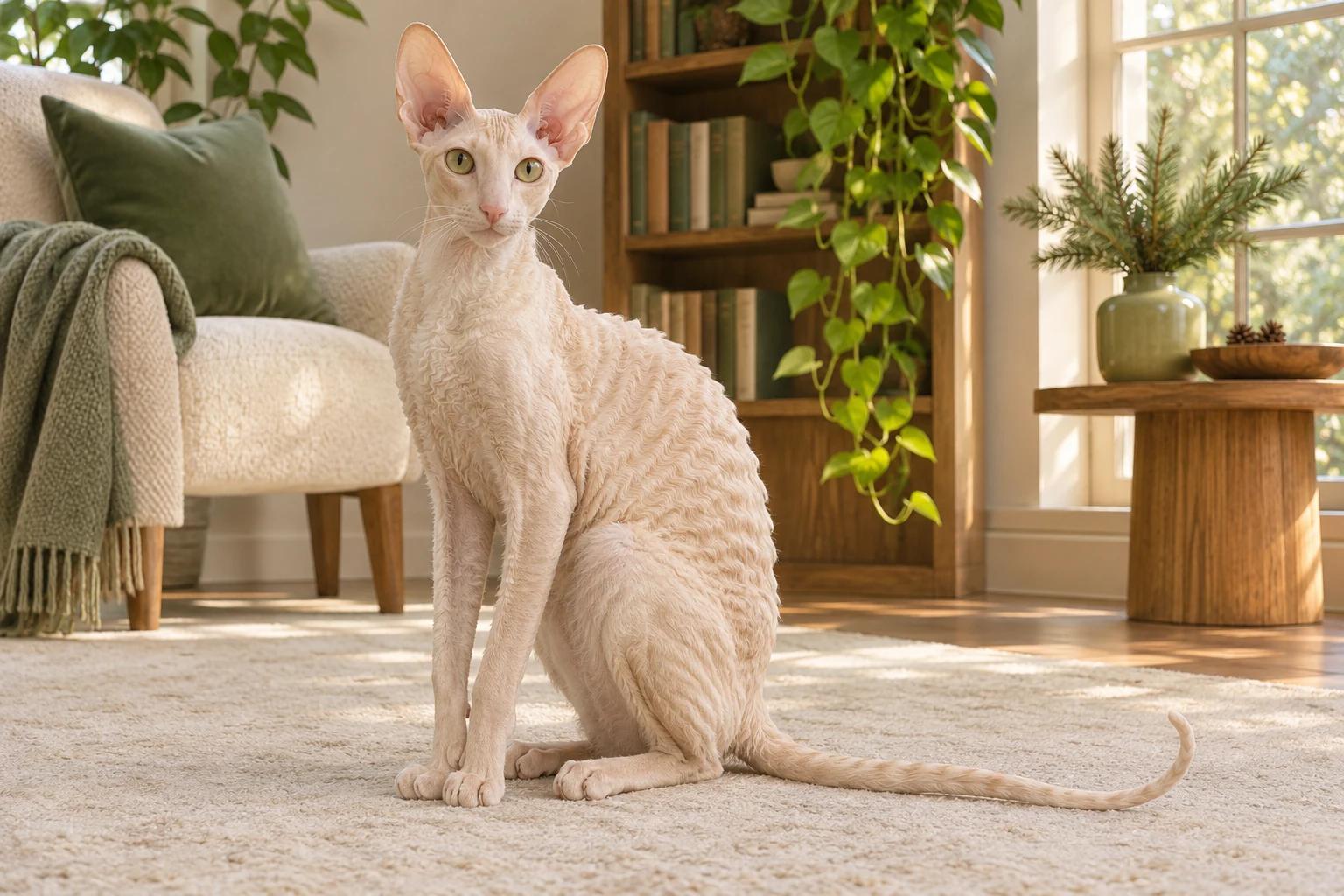
Cornish Rex training can include practical everyday skills as well as movement games. The useful distinction is between knowing exactly what you want to teach and assuming that a breed label supplies the lesson. Choose a clear task, then use an appropriate teaching method rather than looking for one universal test of how clever your cat is.
Cornish Rex training belongs in a three-dimensional home
CFA's anniversary account of the Cornish Rex describes a breed that uses vertical space as well as running room. It also describes household objects becoming playthings and interest shifting from one object to another. Those are useful details when deciding where a lesson happens.
Look beyond the patch of floor where you are standing. A nearby shelf, chair back or object on a table may be part of the cat's available route through the room. An appealing object beside the lesson can become an alternative activity, rather than evidence that the cat has rejected learning itself.
Applying that description does not mean constructing taller and taller challenges. Instead, consider the room from the cat's position: what is within reach, what can be investigated, and which loose objects belong elsewhere before you begin? The goal is a clear place for one activity, not a room full of competing invitations. Keep the lesson's purpose separate from the animal's opportunity to explore its home. A Cornish does not have to demonstrate every possible movement during each session.
Make entering the carrier an everyday skill
Woodgreen's carrier-training guide builds the task gradually. Begin between journeys, not when departure is imminent. Its sequence can start with treats on familiar bedding away from the carrier, then move the bedding nearer while the cat is elsewhere. Do not slide occupied bedding toward the carrier.
A carrier with a removable top allows practice with the base first. Place the bedding inside in stages. Introduce the top separately, then replace it before the cat enters, rather than enclosing the cat unexpectedly. If that change makes entering difficult, return to an easier stage.
Closing the door is another lesson: move it a little, reopen it and reward, building gradually while the cat remains comfortable. Lifting comes later, beginning with touching the handle and then a small lift and gentle replacement. These are separate achievements, not one event called “carrier trained.”
For Cornish Rex socialization, this practical example also shows why familiarity with one part of an experience should not be mistaken for comfort with everything that follows. Walking inside voluntarily is a useful beginning; it does not establish readiness for a complete journey.
A turn starts with one small movement
Karen Pryor Academy's spin lesson describes trainer Megan Ramirez teaching her cat Pavlov after he already understood hand targeting. She moved her hand near his nose in a small circle, marked even a small step in the intended direction with a click, and rewarded it.
The complete circle came gradually. Only once the movement was consistent did she say the cue before moving her hand, eventually reducing the hand target. This is a general cat-training example, not research showing a special Cornish learning speed.
For someone asking how to train a Cornish Rex, the sequence matters more than making the first attempt resemble the finished trick. A small step is progress toward a turn; it need not be dismissed because it is not yet a circle. Likewise, a cat following a visible hand is responding to a different level of assistance from a cat responding to the word alone. Do not describe those as the same accomplishment. Work within the cat's comfortable movement rather than turning a simple trick into a contest for tightness or speed.
Teach an obstacle before imagining a whole course
In CFA's agility-training article, Chris and Linda Shaffer describe teaching individual obstacles rather than depending only on a fixed course layout. For a very low hurdle, the example begins with a cat already familiar with touching a target. The target moves far enough beyond the hurdle that the cat steps over to reach it; the movement is marked and rewarded.
The article emphasizes practicing from both sides. That is a concrete detail worth retaining: crossing from left to right does not demonstrate the opposite direction. A low step-over can be the whole exercise, without increasing height.
The same account describes guiding a cat through a tunnel with a target and practicing from each entrance. These examples offer different routes for a willing learner, not compulsory tests of Cornish Rex obedience. They also distinguish understanding one obstacle from following an entire sequence. A successful crossing is already a definable skill. Adding a second obstacle introduces a different arrangement; it need not happen immediately, and there is no need to reproduce a competition course at home.
Keep breed information separate from a training result
The Cornish Rex profile provides the wider breed overview. Its adult references distinguish females at five to seven pounds from males at eight to ten pounds. Neither interval establishes that an individual has learned a cue. Size, sex and a pedigree name are not substitutes for describing the actual action you have taught.
For a separate ownership topic, see Cornish Rex indoor clothing questions. The cat match quiz is for comparing ownership preferences, not awarding training qualifications. You can value a particular companion without needing a certificate, an audience or a collection of impressive tricks.
Frequently asked questions
Does a learned movement need to look impressive?
A learned Cornish Rex movement need not look impressive. Describe the action accurately rather than judging its entertainment value; an ordinary useful skill still matters.
Does the Cornish Rex name establish obedience?
The Cornish Rex name identifies a breed, not a completed lesson or standardized training qualification.
Must every owner aim for public performance?
Cornish Rex training can aim at private, practical cooperation rather than public performance. Ownership does not require demonstrations or comparisons with another person's cat.
Sources behind this article
- CFA Cornish Rex anniversary article ↗
- Woodgreen carrier training ↗
- Karen Pryor Academy spin training ↗
- CFA agility training by Chris and Linda Shaffer ↗
Article source checked: November 16, 2026. Source checked 2026-11-16
Keep reading

Abyssinian Cat Training: Useful Skills for an Active Cat
Read article →