Clumber Spaniel Temperament: Company, Play, and Manners
Explore Clumber personality through everyday company, play, teaching, visitors, and the practical needs of a substantial spaniel.
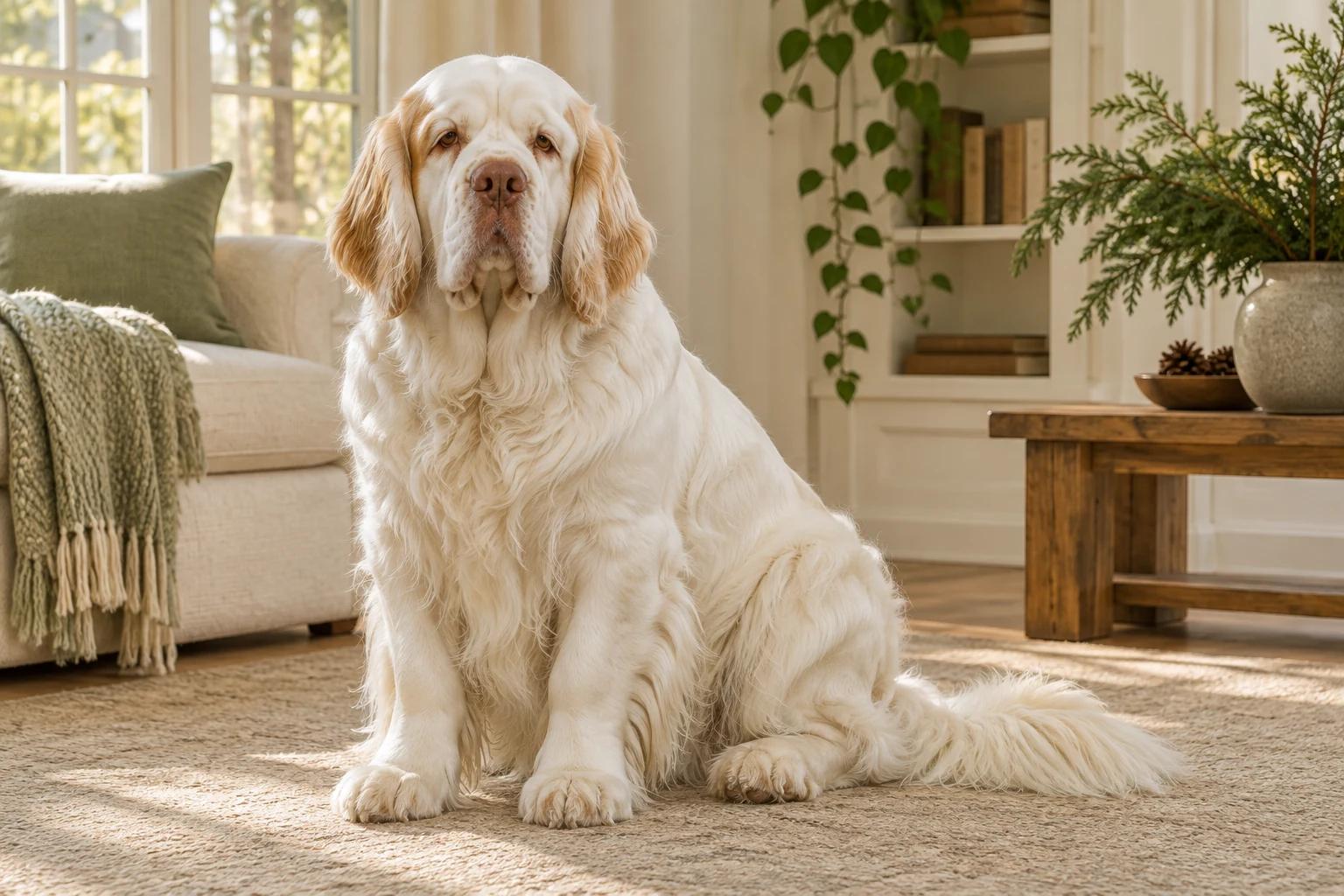
Clumber Spaniel temperament is often summarized by a calm expression and an imposing body, but neither tells you what the dog will do with a free afternoon. A useful picture includes affection, play, curiosity, and ordinary household participation. The aim is not to find a dog that needs nothing from you. It is to decide whether the Clumber's style of companionship fits the way you actually live.
Clumber Spaniel temperament beyond the solemn face
The UKC standard pairs a dignified appearance with enthusiasm for work and play, alongside affection and loyalty. VCA's breed account describes a dog that can enjoy both leisure and retrieving. Together, those descriptions suggest a better question than “Is the Clumber lazy?” Ask what draws the individual dog into activity and what helps it settle afterward.
When meeting an adult, watch a familiar person offer an ordinary interaction. Does the dog bring a toy, follow into another room, or choose to stay close without much movement? Those observations help make Clumber Spaniel personality concrete. They also reveal whether your idea of companionship matches what this dog enjoys.
Do not use a single sleepy visit as evidence that the dog will never want a walk or game. Equally, a lively greeting does not describe every evening at home. Ask the current carer to walk you through a normal day, including the quiet intervals between the interesting events.
A substantial companion needs practical manners
The Clumber's physical scale matters to everyday relationships. Before arrival, decide where the dog can rest without blocking the route between rooms. Place a bed where it can share company while people can still move around freely. A companion who likes to be near you should not have to be stepped over whenever someone gets up.
Teach a clear invitation to move from one resting place to another. Start when nothing urgent is happening, reward the move, and let the dog return or settle elsewhere as appropriate. That is more workable than discovering during a rushed morning that the only household strategy is pushing a sleeping dog out of the way.
The same principle applies at doors. Organize shoes, bags, and walking equipment before inviting the dog into the entrance area. Practise waiting while you handle a latch and moving through together. You are creating an understandable sequence, not requiring a solemn-looking spaniel to infer good manners from its appearance.
Play can be part of communication
VCA recommends game-like, reward-based learning with this breed. Use that idea to connect a small request with something the dog actually wants. For a toy-interested Clumber, an easy return toward you can lead to another opportunity to play. For another individual, attention or a suitable food reward may be more useful.
Keep the skill clear. If the dog is learning to bring a toy toward you, do not simultaneously demand a perfect position, a prolonged wait, and a formal delivery. Choose one part to recognize. You can build the sequence as understanding grows rather than making the first attempt a test of several unfinished skills.
Avoid turning an object in the dog's mouth into an automatic chase around the house. Put unsuitable objects out of reach and ask a reward-based trainer to help you teach exchanges when needed. Management is especially valuable while a new dog is still learning which belongings are available for play.
Company, visitors, and expectations
The Clumber profile describes strong family interest and a relatively sociable tendency. That gives you a starting point, not a duty to arrange constant greetings. Visitors can enter, settle, and allow the dog to approach without making its response the central event of the visit.
If the dog would rather watch, let it. A greeting that remains optional can tell you more than one created by pulling the dog forward. For busy gatherings, prepare a separate resting option and make sure someone is responsible for doors. Hosting people and monitoring a dog are separate jobs even in a friendly household.
Children and dogs need supervision and space; a mellow reputation does not guarantee a suitable interaction. Agree that the dog's resting area remains undisturbed. If another animal lives with you, obtain specific information about the Clumber's previous experience and arrange introductions deliberately. Neither a spaniel label nor a photograph beside another dog establishes compatibility.
Build a balanced ordinary day
Among the most useful Clumber Spaniel characteristics for planning is that leisure and participation need not be opposites. Offer opportunities to go out, investigate, learn, and play, then provide a comfortable place to rest. Do not make the daily routine depend on either relentless entertainment or the assumption that the dog will sleep whenever you are busy.
A workable example is an outing followed by a quiet household interval, another opportunity for interaction later, and familiar cues around meals and bedtime. The details should match the individual, your schedule, and any veterinary advice. There is no universal exercise duration hidden in the word mellow.
Plan care for the days you cannot follow the normal routine. A delayed workday, repair visit, or trip should not leave you deciding at the last moment who will provide company and outdoor access. Ask about the dog's actual experience of being alone before designing your absence plan.
Describe behavior precisely
Clumber Spaniel behavior is easier to discuss when you report an event rather than a character flaw. “He stayed beside the toy when I reached for it” is more informative than “He is stubborn.” “She did not come through the busy doorway” gives a trainer something to investigate; “She is lazy” closes the question too early.
Record the context, what you asked, and the response. If behavior changes suddenly or suggests discomfort, consult a veterinarian. For teaching problems, choose a professional who will observe your setup and use reward-based methods. You do not need to make the dog fit a breed description before seeking support.
Use the breed match quiz to compare your preferences for company, activity, and practical care. The separate history article covers the Clumber's background; evaluating a prospective companion calls for present-day observations rather than assumptions drawn from an old estate story.
FAQ
Are Clumber Spaniels always inactive indoors?
No. Breed descriptions include enjoyment of both leisure and play. Ask how the individual dog behaves between outings, during family activity, and when offered a game. A sleepy expression is not a complete activity profile.
Does a calm temperament mean training is unnecessary?
No. Doorways, resting places, equipment, and exchanges still need clear teaching. A substantial dog benefits from practical manners that people can use consistently, even when its general manner is relaxed.
What should I ask before adopting an adult Clumber?
Ask about ordinary routines, preferred games, handling, visitors, other animals, and observed behavior during absences. Request concrete examples. Those details are more useful than a general reassurance that the dog is easygoing.
Sources behind this article
Article source checked: November 15, 2026. Source checked 2026-11-15
Keep reading

Airedale Terrier Temperament: What Everyday Life Can Feel Like
Read article →