British Shorthair vs Russian Blue
Compare British Shorthair vs Russian Blue through current adult weights, coat and body structure, games and individual social preferences.
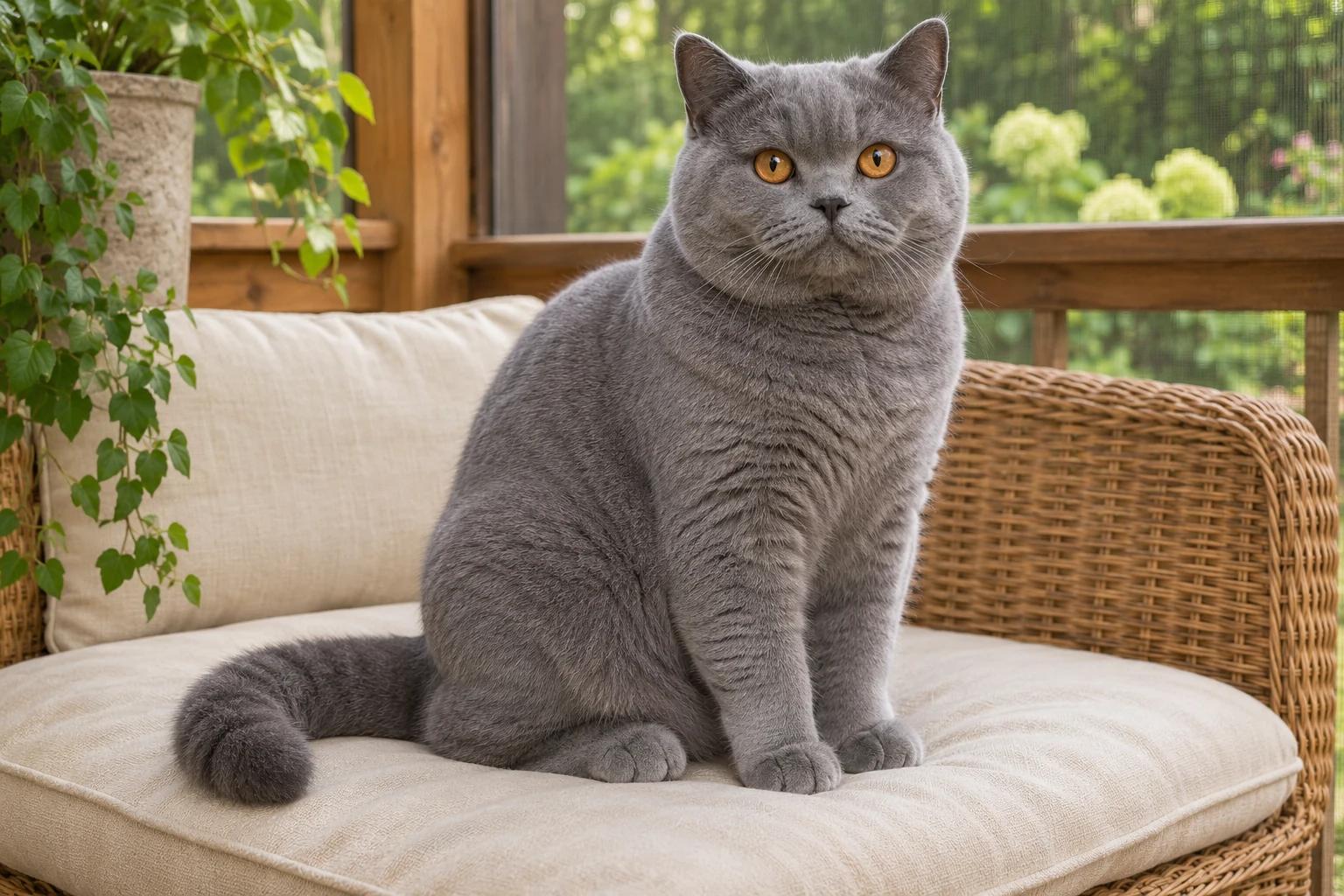
British Shorthair vs Russian Blue starts with identifying the breeds accurately, not deciding which photograph has the nicer shade of grey. The current British Shorthair profile and Russian Blue profile describe distinct companions. Their adult weight references are useful starting points, but they do not tell you how a particular cat will interact with your home or which activities it already enjoys.
British Shorthair vs Russian Blue: the adult weight overlap
The British Shorthair reference is 8–11 pounds for females and 10–16 pounds for males. The Russian Blue reference is 7–10 pounds for females and 10–12 pounds for males. Compare like with like rather than putting a British male beside a Russian female and treating the result as a complete breed comparison.
The female ranges overlap at 8–10 pounds; the male ranges overlap from ten through twelve pounds. An eleven-pound male therefore could fit either reference. The difference between British Shorthair and Russian Blue cannot be reduced to one breed always being heavier than the other.
For an individual decision, use that cat's actual adult measurement where available. A kitten's present weight does not settle its future adult size, and a visual estimate is not the same as a scale reading. If weight or development is a concern, discuss the individual with a veterinarian instead of choosing a breed-range endpoint as a target.
Short British hair still has a defined texture
The Canadian Cat Association's British standard describes the shorthair coat as dense, crisp and resilient. It also treats British Shorthairs and Longhairs as separate breeds for judging. “British” alone is therefore not a complete coat description when a listing leaves the variety unclear.
The shorthaired description concerns texture as well as visible length. A photograph cannot tell you how a coat feels, and a soft-focus image can blur the distinction between a defined short pile and longer hair. Ask which variety the animal actually is rather than interpreting every generous outline as the same coat.
CCA also distinguishes solid colors from patterned coats in its judging framework. That is an appearance classification, not a personality ranking. A preference for one look should not become an assumption that all British cats of that color behave alike. In a Russian Blue vs British Shorthair search, establishing breed and coat variety gives you a clearer starting point than relying on an informal nickname such as “blue cat.”
The Russian outline combines a wedge head with a graceful body
CFA's Russian Blue description identifies a medium-long, graceful body, a modified wedge-shaped head and large ears that are broad at the base. The dense short coat has silver-tipped guard hairs, giving it a distinctive sheen. Green eyes are another familiar feature.
Consider that combination rather than identifying the breed from a blue coat alone. A head-and-shoulders portrait can show the eyes and ears while hiding the body's proportions. A whole-body view is useful when learning what the description means, particularly if the animal is standing naturally rather than curled into a resting position.
These are features of appearance, not evidence that one cat is a better companion than another. The silvery effect changes with illumination, so a darker photograph does not automatically describe a different kind of animal. Look for a coherent account of the cat's identity and history, then meet the individual. A collection of matching visual features can help you understand a description; it should not replace knowing what animal is actually being offered.
A reserved arrival can still belong to an active companion
TICA's Russian Blue account describes opportunities for retrieving, learning tricks, manipulating puzzle toys and exploring elevated places. These are specific activities to discuss with a current caregiver, not a promise that every Russian Blue will perform every game immediately.
For example, a cat with a familiar retrieving game already has a history with a particular object and person. Asking it to repeat the performance with a new visitor may not show the same result. Likewise, interest in an elevated observation point should be understood as part of that individual's environment, not as a requirement to buy the highest structure available.
When choosing a British Shorthair or Russian Blue, compare activities you can actually offer with activities the cats choose. Do not assume that a quiet first meeting settles how much involvement the animal will want once familiar with you. Mental engagement and movement can take different forms; an enjoyable household game does not have to look like a spectacular demonstration for an audience.
Familiar people and visitors may see different behavior
VCA's Russian Blue account describes affection toward favored people alongside reserve around strangers. It also notes that an individual may entertain itself with toys when a person is not available to join in. Those observations are more useful than treating an unfamiliar visitor's first impression as the entire personality.
A prospective owner should distinguish “did not approach me today” from “never seeks company.” The first describes an encounter; the second is a much broader claim that the encounter cannot establish. Equally, a story about affectionate behavior with a familiar caregiver is not a guarantee of immediate identical behavior with you.
Keep both kinds of information in view. Meet the animal without demanding that it prove a description, and ask what ordinary interaction looks like with people it knows. This avoids making a permanent judgment from one unfamiliar situation while still taking the actual meeting seriously. Neither breed should be selected solely because you imagine its name guarantees a particular amount of attention, independence or physical contact.
The British Shorthair measured-meals guide covers feeding organization separately. The cat quiz helps you consider broader ownership preferences.
FAQ
Can an eleven-pound male fit either breed's reference?
An eleven-pound adult male fits both British Shorthair and Russian Blue weight ranges; that number cannot identify breed.
Which female weights overlap?
Female British Shorthair and Russian Blue adult weight references overlap at 8–10 pounds. Compare the individual cats rather than assuming every British female is heavier.
Is a kitten's current weight its predicted adult weight?
A British Shorthair or Russian Blue kitten’s weight is not its predicted adult weight; these describe different life stages. Individual development needs its own veterinary context rather than a guess from one measurement.
Sources behind this article
- CCA British standard ↗
- CFA Russian Blue ↗
- TICA Russian Blue ↗
- VCA Russian Blue ↗
- Hill’s adult reference — adult-weight reference ↗
- British Shorthair adult-weight reference ↗
Article source checked: November 16, 2026. Source checked 2026-11-16Article source checked: November 18, 2026. Source checked 2026-11-18
Keep reading

Abyssinian vs Somali: Coat, Size and Everyday Company
Read article →